A launch can expand to fill every available hour if you let it.
What begins as a focused plan to introduce an offer becomes a new sales page, a complete website rewrite, three lead magnets, daily content, a brand photo shoot, twelve emails, and a growing list of details that suddenly feel essential.
Meanwhile, your existing work still needs attention. Clients still need replies. Orders still need to go out. Dinner continues to occur every evening with remarkable consistency.
Learning how to plan a small business launch is partly about marketing. It is also about scope, capacity, sequencing, and deciding what does not need to happen right now.
A strong launch does not require you to disappear into your business for six weeks. It requires a clear offer, a thoughtful path to purchase, enough communication to help people decide, and a plan your actual life can support.

Begin With the Decision You Want Someone to Make
Before creating content or building a timeline, define the decision at the center of the launch.
What, specifically, are you inviting someone to do?
The answer should be more precise than “buy my offer.”
For example:
- Book a consultation for a particular service
- Join a program before enrollment closes
- Purchase a digital product at an introductory price
- Reserve one of a limited number of project dates
- Join a waitlist for an upcoming offer
- Upgrade from an existing product to a more comprehensive option
Then define who the invitation is for and why that person would consider it now.
A simple launch statement can help:
This launch invites [specific audience] to [specific action] so they can [specific result], with [relevant reason to act now].
This statement is not necessarily customer-facing copy. It is a filter for your planning.
If an idea does not help the right person understand the offer, trust it, or take the next step, it may not belong in the launch.
Choose One Primary Launch Goal
A launch becomes difficult to manage when it is expected to accomplish everything at once.
You may want to:
- Generate revenue
- Grow your email list
- Increase brand awareness
- Test a new offer
- Fill a specific number of spaces
- Re-engage a dormant audience
- Gather feedback
- Build a reusable campaign
- Establish authority around a topic
Several of these outcomes may occur, but one should lead.
Your primary goal shapes the strategy.
If you are testing demand, a leaner campaign with personal outreach and a simple sales page may be appropriate.
If you are opening a limited number of service spots, clarity and qualification matter more than reaching the largest possible audience.
If the goal is list growth before a future launch, the campaign should prioritize the opt-in experience rather than trying to sell a complex offer immediately.
Choose one primary goal and one secondary benefit. Let the remaining possibilities be welcome outcomes rather than additional assignments.
Decide What Kind of Launch You Are Planning
Not every offer needs a large campaign.
Match the size of the launch to the size, maturity, and risk of the offer.
A soft introduction
Use this when the offer is new, the audience is small, or you want real-world feedback before investing heavily.
A soft introduction might include:
- A concise offer page
- An email to your existing audience
- A handful of social posts
- Personal invitations to well-matched contacts
- A defined period for collecting questions and feedback
A focused campaign
This works well for an established service, a digital product, a seasonal promotion, or an offer with a clear enrollment period.
It might include:
- A complete sales page
- A short email sequence
- A coordinated set of social content
- A live session, preview, or useful launch resource
- A defined open-and-close period
An extended launch
A longer campaign can be appropriate for a higher-investment offer, a major new product, or something that requires more education and trust.
It may involve:
- A waitlist period
- Pre-launch educational content
- A longer email sequence
- Partnerships or guest appearances
- Multiple opportunities to experience the method or concept
- A more developed follow-up plan
Larger does not automatically mean more effective. Choose the lightest launch structure capable of supporting the decision you are asking someone to make.
Plan the Launch Around Capacity, Not Optimism
Most launch plans assume a version of you who has uninterrupted workdays, consistent energy, no client emergencies, and a sudden enthusiasm for writing promotional emails at 9:30 p.m.
Plan for the version of you who actually runs the business.
Start by listing the commitments that will continue during the launch:
- Client delivery
- Customer support
- Order fulfillment
- Administrative work
- Meetings
- Family or caregiving responsibilities
- Personal appointments
- Rest and exercise
- Household tasks
- Existing content obligations
Then decide how many hours you can realistically give the launch each week without borrowing heavily from sleep, relationships, or current customers.
That number is your launch capacity.
If you have six hours available, build a six-hour plan. Do not create a fifteen-hour campaign and hope efficiency will somehow close the gap.
Leave part of your capacity unassigned
Avoid scheduling every available hour.
A useful launch calendar includes space for:
- Technical problems
- Revisions
- Customer questions
- Delayed approvals
- Low-energy days
- Opportunities you could not anticipate
Unassigned capacity is not wasted. It is what allows the plan to remain intact when real life enters it.
How to Plan a Small Business Launch Backward
Once you know the launch date and available capacity, plan backward from the customer’s experience.
Begin with the moment someone purchases, books, applies, or enrolls.
What must be ready for that moment to work smoothly?
That might include:
- A clear sales or service page
- Checkout, booking, or application functionality
- Confirmation emails
- Payment settings
- Delivery instructions
- Onboarding materials
- Customer support information
- Policies and frequently asked questions
Next, ask what someone needs before making the decision.
They may need to understand:
- What the offer includes
- Who it is designed for
- What problem it addresses
- What makes it different
- How the process works
- What it costs
- What happens after purchase
- Whether it fits their current situation
- Why the timing matters
These questions determine your launch content.
Planning backward keeps you focused on the buying experience instead of producing promotional material simply because launches are supposed to contain it.

Use a Six-Week Launch Framework
Not every launch needs six weeks, but this framework provides a useful starting point. Compress or extend it according to the complexity of the offer and the size of the campaign.
Week One: Decisions and scope
Use the first week to define:
- The offer
- The audience
- The primary promise
- The price
- The launch dates
- The primary goal
- The main call to action
- The assets you will and will not create
This is also the week to identify unresolved decisions. A launch cannot move efficiently while the offer itself is still changing every afternoon.
At the end of the week, create a short scope statement:
This launch includes [core assets]. It does not include [deferred ideas]. New ideas will be saved for a later campaign unless they solve an essential problem.
Week Two: Offer infrastructure
Build and test the path someone will use to take action.
Prioritize:
- Sales, service, or booking page
- Checkout or inquiry form
- Confirmation page
- Automated emails
- Payment and scheduling settings
- Onboarding or delivery process
- Mobile usability
- Links and tracking
Complete the functional pieces before spending hours perfecting launch graphics.
A beautiful campaign cannot compensate for a confusing purchase process.
Week Three: Core messaging and content
Write the central message before creating individual posts.
Develop:
- One clear description of the offer
- The primary result or transformation
- Three to five supporting messages
- Answers to the most relevant objections or questions
- The story behind the offer
- A clear explanation of the next step
These ideas become the source material for your emails, social posts, website copy, and conversations.
The objective is not to invent a different message for every channel. It is to express the same useful ideas in formats appropriate to each one.
Week Four: Audience preparation
Begin discussing the problem, desire, or decision connected to the offer before asking people to purchase.
You might share:
- A useful perspective on the problem
- A behind-the-scenes look at why the offer was created
- A common mistake or misconception
- A small part of your process
- A customer question you hear often
- A relevant personal observation
- A preview of what is coming
This phase should help the audience understand the context for the offer. It should not feel like several days of vague suspense.
Week Five: Launch
Open the offer and communicate clearly.
Tell people:
- What is available
- Who it is for
- What it helps with
- How it works
- What the timing or availability is
- Where to learn more
- What action to take
Continue sharing throughout the launch period, but vary the angle rather than repeating the same announcement.
One message might focus on the result. Another can explain the process. A third might answer questions. Another may help someone decide whether the offer is appropriate for them.
Week Six: Follow-up and delivery
Once the promotional period ends, the work is not finished.
Use this week to:
- Welcome new customers or clients
- Confirm delivery and onboarding
- Respond to remaining questions
- Follow up with interested people when appropriate
- Record results
- Save useful customer language
- Document what worked
- Rest before making major strategic judgments
A considered follow-up protects both the customer experience and the value of everything you learned during the launch.
Build a Lean Launch Kit
A launch does not need dozens of assets to feel complete.
For a modest small business launch, a lean kit might include:
- One sales, service, or booking page
- One announcement email
- Two to four follow-up emails
- Three to six core social posts
- Several stories or shorter reminders
- One frequently asked questions resource
- One confirmation or onboarding email
- A simple place to track questions and results
The exact number matters less than whether each piece has a clear role.
Before adding another asset, ask:
- Does this answer a question the audience genuinely has?
- Does it reach people in a meaningfully different way?
- Is it necessary for the buying experience?
- Can an existing piece be adapted instead?
- What would happen if I did not create it?
If you cannot name the purpose, it is probably not essential.
Create One Message Bank Before Creating Content
Writing each launch post from scratch creates more work than the launch requires.
Instead, build a message bank first.
Include:
The offer in one sentence
Describe what it is, who it is for, and the useful outcome.
The problem in the customer’s language
Write down the phrases your audience might use to describe the frustration, gap, or desire connected to the offer.
The core benefits
Focus on what becomes easier, clearer, faster, more enjoyable, or more effective.
The process
Explain what happens after someone purchases, books, or joins.
Common questions
List the practical questions that could delay a decision.
Reasons for the timing
If there is a deadline, limited availability, introductory price, seasonal relevance, or scheduled start date, explain it plainly.
Stories and examples
Collect behind-the-scenes observations, client questions, personal experiences, or project details that make the offer more tangible.
Once the message bank exists, content becomes an adaptation exercise rather than a daily invention exercise.

Give Every Piece of Content One Job
A single post does not need to introduce the offer, explain every feature, overcome all objections, prove your expertise, share your origin story, and create urgency.
Assign one job to each piece.
A launch email or post might be designed to:
- Create recognition
- Explain the offer
- Demonstrate the process
- Answer a question
- Show the relevance of the result
- Address a concern
- Clarify who the offer is not for
- Remind people about timing
- Invite a direct next step
This makes the content easier to create and easier to absorb.
The campaign as a whole carries the full message. Each individual piece only needs to move the conversation forward.
Reuse the Idea, Not Just the Caption
Content reuse works best when you adapt the central idea to each format.
Suppose one of your core messages is that a thoughtful system reduces decision fatigue.
That message could become:
- An email explaining the idea in depth
- A short social post with one practical example
- A carousel showing the before-and-after process
- A story answering a related question
- A section on the sales page
- A talking point for a live session
- A follow-up email for someone who clicked but did not purchase
You are not repeating yourself carelessly. You are giving the same important idea several opportunities to be understood.
Most people will not see every piece of launch content. Those who do are likely to benefit from the reinforcement.
Protect the Work That Keeps the Business Running
A launch should not damage the rest of the business.
Before launch preparation intensifies, identify the non-negotiable operating floor.
This may include:
- Client deadlines
- Customer response times
- Shipping or fulfillment days
- Invoicing
- Payroll or contractor communication
- Essential maintenance
- Existing commitments
Decide what can temporarily happen less often and what cannot.
Perhaps regular blog publishing pauses for a week. Maybe meetings are grouped into fewer days. Nonessential improvements can wait until after the campaign.
Tell current clients about any relevant schedule changes before they experience them.
The launch is one business activity. It should not make every other activity feel neglected.

Design a Launch Week Rhythm
Without a rhythm, launch week can become a cycle of checking numbers, changing plans, and posting whenever anxiety rises.
Create a simple daily structure.
Morning review
Check essential information once:
- Purchases, bookings, or applications
- Customer questions
- Technical issues
- Scheduled content
- Anything requiring an immediate response
Avoid interpreting every number as a verdict on the entire launch.
Focused promotion window
Set aside a defined period to write, publish, respond, and engage.
This could be one block in the morning and another later in the day. It does not need to become constant online availability.
Customer care window
Respond to relevant questions and make useful updates to frequently asked questions or sales copy.
Customer questions can reveal what needs clarification. They do not always require a new piece of content.
End-of-day close
Record important information, prepare the next day’s communication, and stop.
Choose a time when launch work ends. A launch does not improve simply because you continue looking at it late into the evening.
Decide in Advance What Will Trigger a Change
Launches produce incomplete information in real time. A slow morning can create the urge to rewrite the page, change the price, add a bonus, and alter the campaign before the audience has had time to respond.
Create decision rules before the launch begins.
For example:
- A technical problem is corrected immediately.
- A frequently repeated customer question may be clarified in the copy.
- A new bonus is not added solely because sales feel slow.
- The price does not change during the campaign unless the original information was incorrect.
- Scheduled messaging can be adjusted for relevance, but the entire strategy is not rebuilt mid-launch.
- Major conclusions wait until the launch period is complete.
These rules make it easier to respond thoughtfully rather than emotionally.
Keep a Parking Lot for Good Ideas
Launch preparation tends to generate new possibilities.
You may think of:
- Another bonus
- A companion product
- A new email
- A redesigned website section
- A partnership
- A second audience
- A more elaborate content series
- A future version of the offer
Some of these ideas will be excellent. They still do not need to enter the current launch.
Keep a document labeled “Later Launch Ideas.” Add new ideas there without assigning them immediate work.
This allows you to preserve creative momentum without expanding the present scope.
Plan the Parts of Life That Usually Become Friction
Protecting your life during a launch does not require creating an ideal lifestyle routine. It requires noticing which ordinary tasks become stressful when work is fuller.
Before launch week, consider:
- Which meals can be planned simply?
- When will groceries happen?
- Are there appointments that should be moved or protected?
- Which household tasks matter this week?
- When will you be unavailable for work?
- What kind of movement or rest helps you think clearly?
- Who needs to know that your schedule is temporarily fuller?
- What can be made easier without turning life into another optimization project?
The point is not to choreograph every hour. It is to prevent predictable logistics from competing with the launch at the last minute.
Measure More Than Revenue
Revenue matters, but it is not the only information a launch produces.
After the campaign, review:
Commercial results
- Purchases, bookings, or applications
- Conversion rate, if you have reliable traffic data
- Average order value
- Revenue
- Refunds or cancellations
Audience response
- Email replies
- Clicks
- Questions
- Content saves or shares
- Direct conversations
- Waitlist growth
Offer insight
- Which benefits attracted attention
- Which questions appeared repeatedly
- Which objections remained unresolved
- Which customer language should be reused
- Whether the audience understood the offer correctly
Operational experience
- Which tasks required more time than expected
- Which assets were unnecessary
- What should be created earlier next time
- Where the purchase or onboarding process caused friction
- Whether the launch schedule fit your capacity
Personal sustainability
- Which parts felt energizing
- Which parts felt disproportionately demanding
- Where boundaries held
- What affected sleep, relationships, or existing work
- What you would refuse to repeat
A launch can produce disappointing revenue and valuable information. It can also produce strong revenue through a process you never want to repeat.
Both truths matter when planning the next one.
Write the Debrief Before Memory Becomes Polite
Within a few days of the launch, document what happened while the experience is still specific.
Record:
- What worked
- What did not
- What surprised you
- What customers responded to
- What took too long
- What you would reuse
- What you would remove
- What needs improvement before the next launch
- Which ideas belong in a future campaign
Save the final emails, content, page copy, questions, and results together.
Your next launch should begin with this information, not with a blank document and a vague memory that everything was “a lot.”
A Launch Can Be Important Without Becoming All-Consuming
A launch deserves attention. It does not require total access to your time, identity, home, and nervous system.
The most sustainable plans are often the clearest ones:
- One primary goal
- One defined audience
- One offer
- One path to action
- A small set of purposeful messages
- A realistic capacity limit
- A protected operating floor
- A clear stopping point
You can care deeply about the result while still eating dinner, answering existing clients, taking an evening off, and remembering that the business will continue after the cart closes or the booking window ends.
That is not a lack of ambition. It is how you build a launch process you are willing to use again.
If you would like thoughtful support organizing the strategy, messaging, systems, and online presence behind your next offer, explore the ways to work with Reverie Maven.
YOUR FREE STARTING POINT
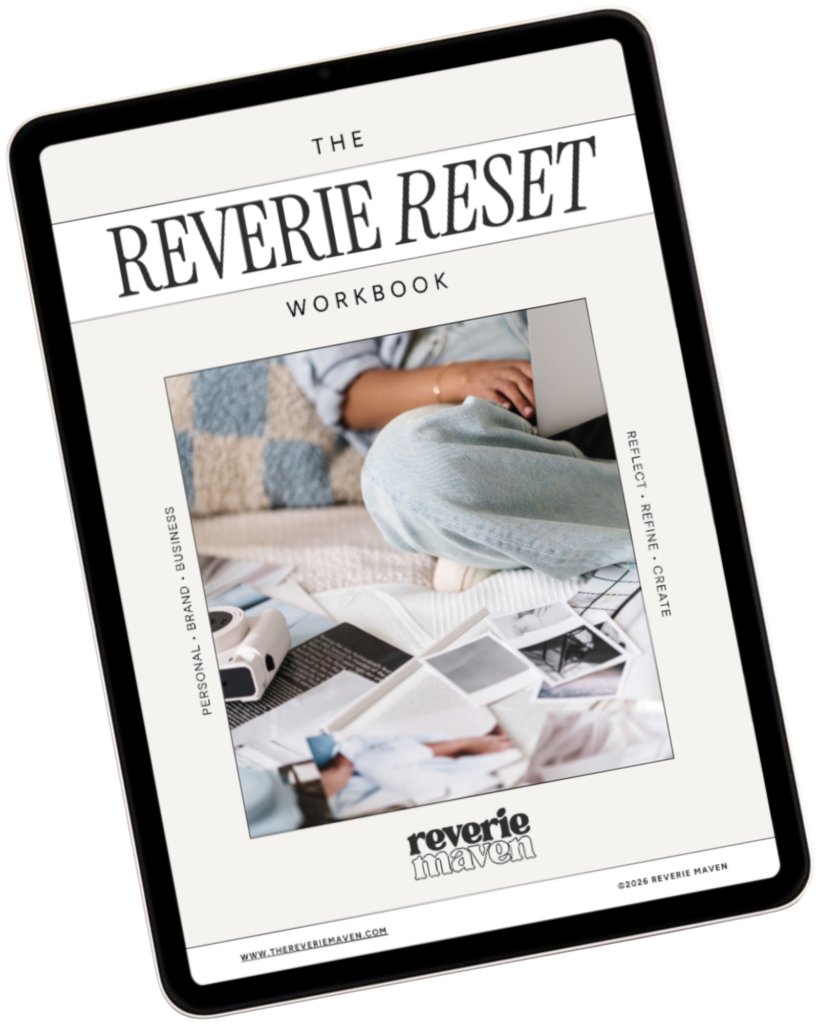
Start with The Reverie Reset
A reflective workbook for reconnecting with yourself, getting clearer about what you genuinely want, and beginning to create a life and presence that feel more aligned, intentional, and fully your own.
Consider this your first step out of “someday” and toward what comes next.