You can recognize certain creative work before you see the name attached to it.
The colors may change. The subject may be different. One project might feel restrained while the next is more expressive. Still, there is a thread connecting them. A way of composing, selecting, editing, or interpreting that makes the work feel like it came from the same mind.
That thread is a creative point of view.
Developing one does not mean choosing a signature color, applying the same treatment to every project, or making your work so consistent that it cannot surprise you. It means understanding the instincts that shape your decisions and learning how to use them with greater intention.
If you have been wondering how to develop a creative point of view that feels distinctive without becoming repetitive, the answer is not to invent a persona or manufacture originality. It is to become more observant about what you already notice, value, and choose.

A Creative Point of View Is More Than an Aesthetic
An aesthetic describes how something looks.
A creative point of view explains why it looks that way.
Two people can work with the same neutral palette, editorial typography, or natural-light photography and produce work that feels entirely different. The distinction comes from the decisions beneath the surface.
One person may value precision and reduction. Another may be drawn to intimacy, imperfection, and personal detail. Someone else might consistently introduce wit into otherwise polished work.
Your point of view influences:
- What you include
- What you remove
- What you emphasize
- What you allow to remain imperfect
- Which references you combine
- How you interpret the brief
- What you want the audience to notice first
- How you want the work to feel after the initial impression
Style is one expression of those choices. It is not the source of them.
This is why chasing a recognizable style too early can make creative work feel less personal rather than more. You begin designing toward a result instead of responding to the idea in front of you.
A stronger approach is to identify the principles that make your choices feel connected, even when the final work changes.
Start With Evidence From Your Existing Work
You do not have to begin with a blank page. Your past work already contains clues.
Gather five to ten pieces that still feel satisfying to you. They do not need to be your most successful, polished, or recent projects. Choose the ones that continue to feel aligned after the excitement of finishing them has passed.
Review them together and look for repetition.
You might notice that you consistently:
- Crop images more closely than expected
- Pair refined design with conversational copy
- Use one surprising element within an otherwise restrained composition
- Favor tactile materials and visible texture
- Create contrast through scale rather than color
- Present practical information in an editorial way
- Leave more visual space than the project technically requires
- Choose language that feels precise but not overly formal
- Build ideas around small everyday details
- Edit until the central concept becomes immediately apparent
Do not focus only on visual similarities. Look at how you approached the problem.
Perhaps your strongest projects began with a personal observation. Maybe you are especially good at making complicated information feel inviting. You may naturally find the emotional detail in a practical subject or bring structure to ideas that initially feel scattered.
Those tendencies are part of your creative point of view, too.
Separate Your Taste From Your Habits
Not every recurring choice is meaningful. Some are simply familiar.
You may use the same font because it is already installed. You might rely on a certain layout because it works quickly, or return to the same photography treatment because you know how to execute it.
A habit says, “This is what I usually do.”
Taste says, “This is what I believe makes the work better.”
To tell the difference, question the choices that appear repeatedly in your work:
- Would I still choose this if I had more time?
- What purpose does this decision serve?
- Does it strengthen the idea or simply make the work look familiar?
- Is this a preference I want to keep developing?
- Am I repeating the choice because it is right or because it is easy?
Some habits will prove worthy of keeping. Others may be disguising themselves as a signature style.
The goal is not to remove every familiar element. It is to make sure repetition comes from conviction rather than convenience.

Identify the Tensions That Make Your Work Interesting
Creative work becomes more distinctive when it contains a specific tension.
Maybe you like things that feel polished but not precious. Feminine but not overly delicate. Intelligent without becoming academic. Minimal without feeling anonymous. Aspirational while remaining useful.
The most interesting point of view often lives between two qualities that could easily pull apart.
Try completing a few of these statements:
- I like work that feels polished, but never __________.
- I want my ideas to be useful without feeling __________.
- I am drawn to simplicity when it still includes __________.
- My work can be aspirational, but it should remain __________.
- I enjoy expressive details when the overall direction feels __________.
- I want people to feel __________ before they notice __________.
Your answers create useful boundaries. They explain not only what you want, but what you are trying to avoid.
“Elegant” is broad.
“Elegant without feeling remote” is a direction.
“Playful” is broad.
“Playful within a disciplined structure” suggests actual decisions.
These tensions give your work character without requiring you to repeat the same visual treatment every time.
Write a Working Creative Thesis
Once you have identified patterns and tensions, turn them into a short creative thesis.
This is not a public-facing mission statement. It is a private decision-making tool.
A useful creative thesis describes:
- What you tend to notice
- What you value in creative work
- How you want your work to affect people
- Which qualities you protect while making decisions
For example:
I create polished, useful work that makes everyday ideas feel more considered. I value strong structure, personal details, tactile imagery, and language that feels intelligent without becoming distant.
Or:
I am interested in the point where editorial restraint meets emotional warmth. My work uses contrast, precise language, and familiar details to make complex ideas feel inviting.
Your thesis does not need to sound impressive. It needs to help you decide.
When reviewing an idea, you should be able to ask whether it supports that direction. If it does not, you can adjust it without depending solely on whether you “like” it.
Treat the thesis as a working document. Refine it as your work develops.
How to Develop a Creative Point of View Through Better Inputs
Your creative point of view is shaped partly by what you consume.
If all of your references come from the same platform, industry, or visual trend, your work may begin to reflect the limitations of those inputs. Even excellent references lose some usefulness when they are too similar to one another.
Expand the material you study.
Look at:
- Magazine pacing and editorial hierarchy
- Film composition and color
- Retail displays
- Hotel and restaurant details
- Book covers
- Exhibition design
- Packaging from unfamiliar industries
- Architecture and interiors
- Menus, tickets, labels, and printed ephemera
- Personal archives and family photographs
- Clothing construction and styling
- The language used in interviews, essays, and criticism
The objective is not to collect more material. It is to encounter different ways of solving creative problems.
When you save a reference, name the principle you want to remember. Instead of writing “love this,” try:
- “The scale makes a small object feel important.”
- “The copy sounds personal because it includes one precise detail.”
- “The limited palette lets the texture do more of the work.”
- “The layout creates energy by interrupting an otherwise orderly grid.”
- “The styling feels elevated, but the subject remains ordinary.”
Specific observations are easier to translate into your own work.
Use Constraints to Make Your Instincts More Visible
Complete freedom does not always produce the most personal work. Without boundaries, it is easy to reach for the most familiar or fashionable solution.
A useful constraint forces you to make choices.
For a creative exercise or low-risk project, try limiting yourself to:
- One typeface family
- Two colors and one neutral
- A single lighting setup
- One repeated shape
- A fixed number of images
- A defined emotional tone
- One central sentence
- A format you would not usually choose
The purpose is not to make minimal work. It is to reveal how you solve problems when the obvious options are unavailable.
If you cannot rely on color, perhaps your compositions become more expressive. If you limit the number of images, you may become more precise about sequencing. If the format is unfamiliar, you might discover a new way of structuring information.
Constraints bring your instincts into focus.
Practice Translation Instead of Imitation
When you find a reference you love, resist the urge to reproduce its most visible features.
Translate the underlying idea into a different medium.
If you admire the pacing of a magazine feature, ask how that rhythm could influence an email sequence. If a fashion campaign feels intimate and cinematic, consider how its cropping or narrative could shape product photography. If an interior feels balanced and inviting, study its proportions rather than borrowing its palette.
A simple translation exercise looks like this:
- Choose a reference outside your immediate medium.
- Identify the principle that makes it effective.
- Apply that principle to a current project.
- Change the subject, format, and execution.
- Review whether the result still feels connected to your own creative thesis.
The distance between the source and the final application creates room for interpretation. That interpretation is where your point of view becomes visible.
Make Several Versions Before Choosing a Direction
The first good idea can become a trap.
Once something looks polished enough, it is tempting to stop exploring. But your most characteristic solution may not be the first one that works. It may appear in the third or fourth version, after you have exhausted the expected options.
Before refining, create several meaningfully different directions.
For example:
- One version that is more restrained
- One that emphasizes personality
- One that is built around a single strong image
- One that relies primarily on typography
- One that removes the element you assumed was essential
Do not create five tiny variations of the same idea. Change the central decision.
Then evaluate each direction against the project’s needs and your creative thesis. You may find that the strongest result combines the structure of one version with the emotional tone of another.
Exploration is not wasted work. It gives you enough evidence to choose intentionally.

Learn to Explain Your Choices
A developed point of view is easier to recognize when you can articulate it.
You do not need a long conceptual explanation for every creative decision. You should, however, be able to describe why the direction serves the project.
Instead of:
“It just felt better.”
Try:
“The closer crop makes the subject feel more immediate, which supports the personal tone of the campaign.”
Instead of:
“I wanted it to look elevated.”
Try:
“The restrained palette and stronger typographic hierarchy make the information feel more considered without reducing its warmth.”
Language makes your instincts easier to examine. It also helps clients, collaborators, and audiences understand that the work is not a collection of arbitrary preferences.
If a choice is difficult to explain, that does not automatically make it wrong. It may simply mean you have not identified the principle yet.
Build Recognition Through Repeated Principles
Recognizable work does not require identical work.
Consistency can come from repeated principles rather than repeated styling.
Your projects might share:
- A preference for strong editorial hierarchy
- A balance of useful information and emotional detail
- A particular relationship between imagery and copy
- An interest in tactile, lived-in materials
- A disciplined use of contrast
- A tendency to make ordinary subjects feel more significant
- A specific level of visual restraint
- A recurring sense of humor or intimacy
These principles can appear in different colors, formats, industries, and moods.
That flexibility matters. A point of view should help you respond more distinctly to each project, not force every project into the same costume.
Ask for Feedback That Reveals Perception
General feedback often produces general answers.
Instead of asking, “Do you like it?” ask questions that show you how the work is being perceived:
- Which three words would you use to describe this?
- What feels most distinctive?
- What feels familiar or expected?
- Where does the work feel most confident?
- Which part seems least connected to the rest?
- What do you notice first?
- What do you remember ten minutes later?
Compare the answers with your intentions.
If people repeatedly notice a quality you value, that may be part of your developing point of view. If the work is being read in a way that does not align with your intention, examine which decisions are creating that impression.
Feedback is most useful when it helps you understand the effect of the work, not when it hands creative authority to someone else.
Let Your Point of View Evolve
Your creative point of view should not remain fixed.
Your taste will sharpen. Your interests will change. New skills will give you more ways to express ideas. Some of your current preferences will deepen, while others will begin to feel less relevant.
Evolution does not erase coherence.
The work can change substantially while retaining the principles that matter most to you. You may use bolder color while keeping the same editorial discipline. Your language may become more direct while preserving warmth. Your imagery might become more experimental while continuing to focus on familiar human details.
Review your creative thesis every few months or after a significant body of work. Ask:
- What am I noticing now that I was not noticing before?
- Which choices still feel aligned?
- What have I outgrown?
- Where am I repeating myself?
- Which recent experiment deserves further development?
- What do I want to become more skillful at expressing?
This keeps your point of view alive rather than turning it into a rulebook.
A Simple Practice for the Next 30 Days
You do not need to wait for a major project to develop a stronger creative perspective.
For the next 30 days:
- Save one reference each day.
- Write one sentence about the specific decision that caught your attention.
- Make one small creative response to a reference each week.
- At the end of the month, review the collection for repeated themes.
- Write three principles that describe what you value.
- Use one of those principles deliberately in your next project.
The exercise is simple, but it moves you from passive admiration to active interpretation.
A creative point of view develops through accumulated choices. The more carefully you observe those choices, the easier it becomes to make work that feels connected, confident, and recognizably yours.
You do not need to become more performative or more predictable. You need to pay closer attention to the decisions that already make your work feel like you.
If you would like thoughtful support turning those instincts into a more cohesive brand or online presence, explore the ways to work with Reverie Maven.
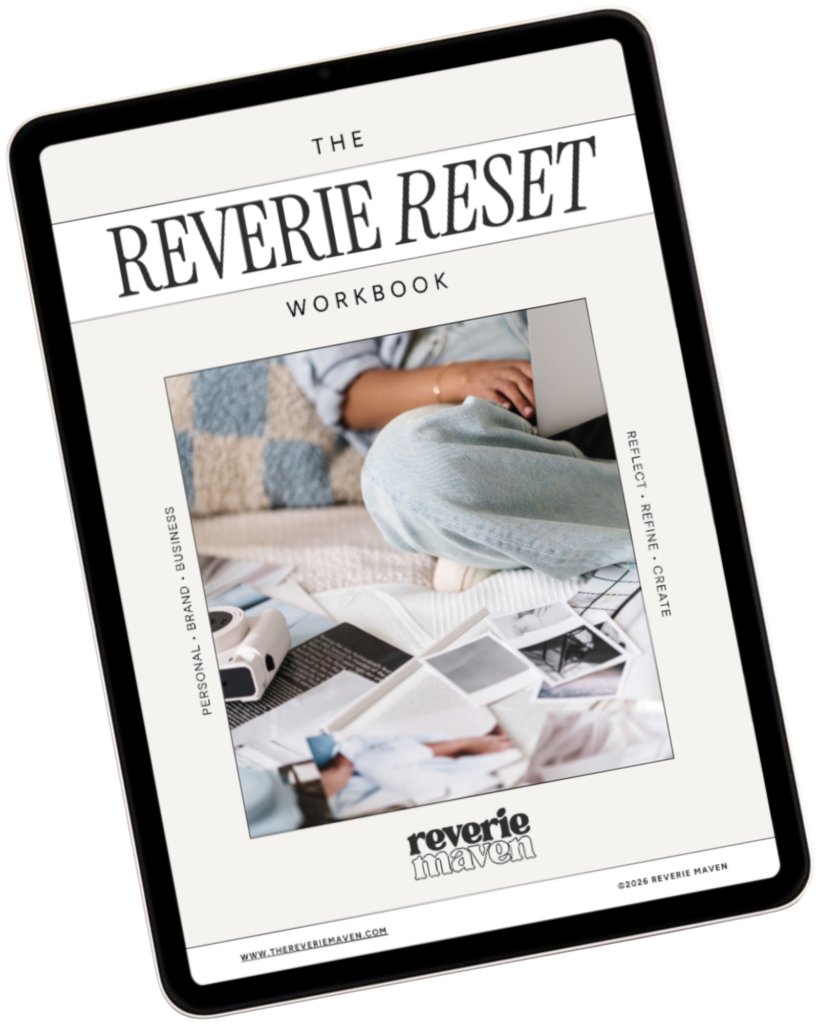
YOUR FREE STARTING POINT
Start with The Reverie Reset
A reflective workbook for reconnecting with yourself, getting clearer about what you genuinely want, and beginning to create a life and presence that feel more aligned, intentional, and fully your own.
Consider this your first step out of “someday” and toward what comes next.